How a residence permit request works at AIMA
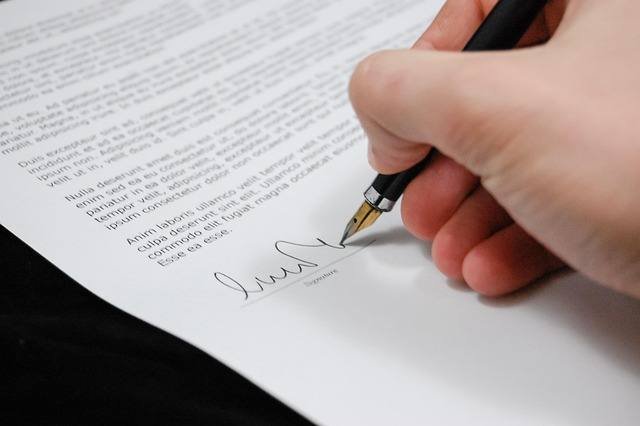
Photo: jarmoluk, Pixabay, Pixabay Content License.
Checked in November 2026. This is a reading of public pages, not a ruling. If an official page disagrees with this guide, follow the official page.
The photograph shows a hand signing a page of placeholder text. It is not an AIMA form and the signature is not an application.
Start with the page that matches the permit
This guide is about the ordinary request for a residence permit, the one AIMA files under article 77, paragraph 1. It is not a script for every visa, and it is not a promise that a visit will end with a card. AIMA’s own permanent residence page says something worth remembering even if you have not yet held a temporary permit for five years: sending a booking is not the same as filing the request, and attending does not guarantee the grant. That sentence is on the permanent page. The general page does not repeat it.
The permanent page is for someone who has already held a temporary permit for at least five years and who meets the other legal conditions. Those conditions, and the papers for the booking, are on that page. This guide does not restate them.
Appointment, shop, and a digital channel that is only partly open
The general page says the request is made by appointment, or through an electronic platform that is being implemented for people who hold a residence visa, and that it is handed in in person with the proper form signed by the applicant or by a legal representative. Any AIMA shop can take it. The page says the shop may then send the file to the service for the area where you live, after the file has been prepared and decided.
The changes page describes a wider digital door, and then says how narrow it is today. A digital channel on the AIMA portal can send, receive and pay for a residence request, and in that case you skip the appointment and the trip. Today, that page names one group: a national of a third country who already lives in Portugal legally, whose household includes children older than 5 and younger than 15, asking for family reunification in Portugal under article 98, paragraph 2, of Law 23/2007 of 4 July, in its current wording. When more request types open, the page says AIMA will publish the criteria on its own platforms.
A shop visit, or assisted digital help in places AIMA will announce, remains possible. A news note of 2 June 2025 is a third, smaller thing. It is an online booking for someone who already holds a residence and work visa that is not a CPLP visa. The note says you choose residence permit, then residence permit with a consular visa that is not CPLP, on contactenos.aima.gov.pt, and you give the passport number, the visa number, and copies of both. That is a booking. It does not replace the papers at the visit.
There is also a FAQ marked, at the top, as content under review. It still contains a line about a digital alternative by the end of 2024. Do not treat that date as a promise. Where the FAQ and the changes page disagree, follow the changes page, and where you need the document list, follow the general page.
Who can walk in with the request
The changes page says the applicant can file, and so can other people, always with the applicant’s authorisation when it is not the applicant. A legal representative, for a child up to the age of 17 or for an accompanied adult. An employer, for subordinate work, a company move, and workers transferred inside a company. A research centre, a university, or another host, for teaching, highly qualified work or cultural work. A school, a training body or another host, for study, research, an internship or volunteering. A third country national living in Portugal who wants family reunification, or the family member who entered legally and who depends on, or lives with, the holder of a valid permit.
What the general page asks you to bring
The general page says the request comes with a valid passport or another valid travel document, a valid residence visa, and proof of means of subsistence. The amounts for those means sit in Portaria 1563/2007 of 11 December, which the changes page cites. This guide does not invent a monthly figure.
You also bring a declaration on your honour of the address, saying on what basis you live there. The page gives examples: owner, tenant, subtenant, usufructuary, borrower, among others. An owner or a usufructuary adds a land registry certificate, or the access code for it. A tenant, or someone in a similar position, adds a declaration from the landlord or from the body providing the housing, naming the legal basis of the use. Kinship papers, when they are relevant. Proof of tax registration, if it applies. Proof of social security registration, if it applies. Health insurance, or proof that you are covered by the national health service.
The form called Modelo 1 is required. Modelo 4, a term of responsibility, is filled in only when it applies. Both are on the general page.
The changes page says AIMA may later read some of this straight from public databases, and that it will announce, on its platforms, when you no longer have to bring a given paper. Until that announcement, the list on the general page is the list. The FAQ, still marked as under review, adds that missing papers can mean a refusal under article 51, paragraph 14, of Regulatory Decree 84/2007 of 5 November. Treat that as the FAQ’s warning, and check it against the general page on the day you go.
For a request that is actually filed on the digital channel, the changes page says the proof can be digital documents signed with a digital certificate, such as the citizen card or the digital mobile key, and in some cases the professional attribute system called SCAP.
What can still block the grant
The general page lists conditions around the grant. Among them: nothing that would have blocked the visa if the authorities had known it, no conviction in Portugal for a crime punished by more than one year in prison, no period in which you are barred from entering or staying after a removal, and no alert of the kind the page describes for refusal of entry, stay or return. The exact list is on that page. A temporary permit, unless a special rule sets another period, is valid for two years from the date the title is issued, and it can be renewed for successive periods of three years.
The fee, without a euro figure
The changes page says the fee is the amount set by Portaria 307/2023 of 13 October, and it points you to the table. It then splits the reduction into three cases. If the digital channel is open for your request and you use it, 25 percent off the in person fee. If that channel is open and you use the assisted digital desk, 10 percent off the in person fee. In the other situations, 25 percent off the amount written in the portaria. This guide will not turn those sentences into a price. The transparency page is where AIMA points for the table of fees.
One trap sits on the changes page for files that were already pending when the new regulatory decree took effect, if money was still owed for the decision. AIMA first writes to the email given with the request, and gives 10 working days to pay the rest. After those 10 working days, if you have not paid, it writes to the address on the AIMA resident register and gives 15 working days. If you still have not paid, you can stop the procedure from ending by paying double the missing amount within 10 days after that deadline. When the legal deadline has passed, the procedure ends and the file is archived.
The contact centre, on the general page and on the changes page, is open Monday to Friday from 08:00 to 20:00. Neither page, in the text read for this guide, printed a phone number, so none is repeated here. The FAQ, marked as under review, says that if the contact form has no option for your case you can write to geral@aima.gov.pt with the subject Pedido de Agendamento, and that you should send that request once.